Friday, 1 May 2015

2015 Elections in Argentina and the United Kingdom. And the Falklands?


With elections on both sides of the Atlantic, we can expect the Falklands to be on the news more throughout 2015. Indeed, Presidential elections in Argentina and General elections in the UK in the months to come. Does it not seem just a little bit too similar to the 1980s dialectic? Both Argentina and the United Kingdom were (and are) going through deep crisis, not necessarily financial ones but social and political. Back in the 80s, it was very convenient for both of them at that time (is it the same now?) for personal and political internal agendas. That is to say, Ms Margaret Thatcher and the Military Junta; Mr David Cameron and Ms Cristina Fernández de Kirchner: the characters seem different. But wait a minute, the play is the same! So it is not that the characters are different but the actors! We are in presence of the same play with the same script played again in the same theatre but now by different actors.

The government of Argentina only knows about either rejecting the Falkland islanders, the British government of, if convenient, the international society and legal order. The British government, sometimes proactive, sometimes reactive. Proactive in inviting the Falkland islanders to ANY negotiations; reactive, to any declaration coming from the Argentinean government.

For a very brief view  of the Falklands’ conflict see the first article of this blog:


And for a more recent account, see Professor Klaus Dodds’ post:


In what if of interest here, Prof Dodd says that:

“In March and April, however, two stories emerged about these islands that make it ripe for coverage. The first involved a parliamentary statement by the Secretary of State for Defence, Michael Fallon, which outlined the findings of a defence review for the Falkland Islands. Citing the risk of Argentine aggression and noting the ‘potential for development of an oil and gas industry’, as well as noting a post-Afghanistan context, the Islands’ military base would be supported by additional helicopters. The communication facilities and air defence systems stationed at Mount Pleasant Airbase are to be upgraded as well. Overall, £180 million has been earmarked for the modernisation of the British military presence.

The second story involved claims via the former NSA whistle-blower Edward Snowden (now exiled in Moscow) that the British government spied on Argentina between 2006–2011 and was intent on infecting Argentine computer systems with viruses and spreading rumour and innuendo in the hoping of discrediting the Argentine government of President Christina Kirchner. At the time of writing, the British government had made no official statement about these allegations but interestingly President Kirchner ordered all the classified Argentine documents relating to the 1982 conflict to be released. She also criticised the British government for allocating further monies to defend the Falklands in the midst of domestic UK austerity.

[…]

While there has been no major oil strike thus far, the UK and Falkland governments are clearly working hard to garner support in Latin America – with an array of trade missions, diplomatic exchanges, cultural visits and military collaboration. Earlier news that Argentina might lease long-range bombers from Russia in return for beef and wheat reminds one of what former UK Prime Minister James Callaghan used to say about ‘dots on the map’ and their capacity to provoke crisis at a proverbial drop of a hat.”


But, what do the Argentinean and British electorate think of the dispute? What do Falkland Islanders have to say about it? What do Argentineans think of the Britons and the Falkland Islanders? What do the Britons know about Argentina and the Falklands?

After almost four decades of hearing the story of Falklands/Malvinas from both sides, more than two decades researching the topic, having lived in Argentina and living in the United Kingdom, being in contact with Falkland Islanders, I can tell that, more often than not, the many take their side depending on their nationality or country of origin without really knowing much about what they are referring to. And not only about the Falklands but in regards a culture as a whole: the English are… the British are … (for instance, do they know English and British mean something different? That the Union Jack and the English flag are two different flags?). And on the other side, the Argentineans are… (When did you go to Buenos Aires? Have you been to Mar del Plata? Do you know there are places in Patagonia where people speak and study in both Welsh and Spanish?). And of course, the Falkland Islands: the islanders, those people … has anyone met a Falkland Islander? Has anyone been to the Falkland Islands? Do you know they have families there that work, pay taxes and send their children to school? Yes, they have children too! They are as human being as any Argentinean or Briton.

Media and social media are part of our daily life but they exist as long as we use and/or buy them. Governments come and go. We elect them, they come; we do not vote for them, they go. They’re our representatives; they’re high ranked civil servants, but civil servants. Unfortunately, some of them cannot separate the public side from the private side, and it is then when private, selfish or self-centred interests come into play. So next time we read or listen to a speech, let’s try to have a critical eye and dissociate that what is simply orientated by selfish, one sided interests from that reflecting what population, the people they represent, want.

Why?  Kofi A. Annan, in his ‘Two concepts of sovereignty’ said it clearly when referring to international intervention in humanitarian crises and it’s perfectly applicable here:  “Because, despite all the difficulties of putting it into practice, it does show that humankind today is less willing than in the past to tolerate suffering in its midst, and more willing to do something about it.” (The Economist, 18 September 1999).

It‘s true, we’re either citizens of one or another country. However, we’re far more than that. We’re part of a broader net called mankind. It’s the time to work together. It’s the time to leave behind selfish, self-centred, one-sided policies or speeches. It’s time to address serious issues with serious agendas by mature representatives. All of us, Argentineans, Britons and Falkland Islanders deserve better. 2015 and elections in Argentina and the United Kingdom: we will hear and see about the Falklands again. But, any real, actual solution to the dispute from Kirchner, Macri, Scioli, Cameron, Miliband, Farage or any other? Doubt it…

Friday, 24 April 2015

Juris North: Legal and Political Philosophy Discussion Group [CALL FOR PRESENTERS]


Juris North, a legal and political philosophy discussion group, in collaboration with the Universities of Birmingham, Durham, Hull, Liverpool, Manchester, and Manchester Metropolitan.


Call for Presenters 2015-16

If your current research is on a topic that can be broadly characterised as jurisprudence—i.e. legal and political philosophy, and you would be interested in presenting it to a friendly group, which includes academics as well as lawyers, you are welcome to be a presenter at the Juris North Discussion Group.

The discussions are normally held on Wednesday afternoons. But we can be flexible about the particular days that we meet. Discussions are always informal and very lively since we follow a Rawlsian approach. That means we do not have “Professors” and “Students” but people interested in discussing issues related to legal and political philosophy. So any question is an important question for debate.

If you would like to give a paper as part of our 2015-16 Working Paper Series then please send an abstract, no more than 500 words long and written in English. If you are interested, please contact Dr Jorge Emilio Nunez j.nunez@mmu.ac.uk.

The seminars will have a ‘pre-read’ format: successful applicants will be asked to send a draft paper two weeks in advance of the seminar so that it can be circulated amongst members of the group.

Accommodation and expenses: we will not be able to make any contribution towards accommodation and travel expenses.


Enquiries please contact Dr Jorge Núñez: j.nunez@mmu.ac.uk


Friday, 17 April 2015

The Force of Law: Law and Coercion, Validity and Effectiveness, and Synergy


The Force of Law:

Law and Coercion, Validity and Effectiveness, and Synergy[1]


JORGE EMILIO NUNEZ

 
Abstract This paper considers the two claims Schauer introduces in The Force of Law. Firstly, the paper seeks to establish that coercion is (a) generally part of the law; and (b) occasionally may be not. Secondly, I intend to demonstrate that despite the fact that the relationship between rules and facts within a normative system could be necessary, sufficient or desirable, in all cases is a synergetic one: they outperform when they work together. Therein, the last section of this paper shows that coercion has philosophical interest in explaining the nature of law since the question whether it is a necessary or sufficient element is irrelevant.

 Available at SSRN: SSRN Link One or SSRN Link Two


[1] A very early version of this paper “нормативные системы как право в синергии: ДЕЙСТВИТЕЛЬНОСТЬ И ДЕЙСТВЕННОСТЬ” (in English, “Normative Systems as Law in Synergy: Validity and Effeciveness”), Philosophy of Law and State Responsibility, St. Petersburg State University, 2012.


Saturday, 11 April 2015

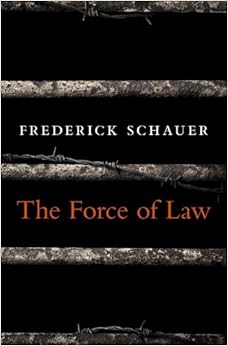
The Force of Law


At last, some sense in legal philosophy. With circular and already-answered-from-the-start discussions for decades about whether a quest in understanding the nature of law—i.e. what is law?—should include coercion, it is The Force of Law that reignites the enquiry long ago thought to be settled. Schauer has two intertwined claims: a) that law is commonly and valuably coercive; and b) a challenge to a prevalent mode of jurisprudence inquiry.


With regards the former, Schauer tells us that “[l]aw makes us do things we do not want to do […] [and] unlike morality and etiquette, possesses the resources to compel compliance in ways that other normative systems do not […]. [For instance], the law has sanctions at its disposal that are systematic, often severe, and highly salient. The legal system can put us in prison, take our money, and in some places even flog us and kill us”. But, for over fifty years legal theory, following H.L.A. Hart has made an assumption that law cannot be identified with force. Indeed, “[t]he theory of law as coercive order meets at the outset with the objection that there are varieties of law found in all systems which, in three principal respects, do not fit this description.” Therein, an opinion translated into dogma: law may refer to coercion but it does not need to by default—i.e. coercion is not a necessary condition for law to be.

Schauer agrees that “noncoercive law both can and does exist.” That is not the issue he intends to unravel in The Fore of Law. However, because we currently understand in legal philosophy that coercion is not a necessary condition for law to be, and legal philosophy seems to be interested only in those features in law that are considered essential, “coercion loses its philosophical or theoretical interest in explaining the nature of law”. And that is Schauer’s second claim, that legal philosophy or legal theory should not be limited to search for essential features, elements, or components.

There are already voices against Schauer’s attempt to reintroduce coercion as a more starring character within law. In his latest paper, Leslie Green “addresses the question of the relationship between law and coercive force”. Green makes, against Frederick Schauer’s claims in his book, The Force of Law, the following points:

“(a) The force of law consists in three things, not one: the imposition of duties, the use of coercion, and the exercise of social power
; (b) Even if coercion is not part of the concept of law, coercion is connected to law in a variety of ways. These are amply recognized in contemporary jurisprudence; [and] (c) We cannot determine how important coercion is to the efficacy of law until we know what counts as coercive force. This question is not a matter for empirical generalization or bare stipulation. It requires an explanation of the concept of coercion. […] Before we can count we need to know that what counts as what. Counting—as is a matter of identifying necessary and sufficient conditions.”
 
 
Despite the apparent disagreements, the focus of this literature, however, is largely on the question of the justifiability of including coercion amongst the elements to be studied when referring to the nature of law. There is a huge literature on the elements that constitute the law. Within this literature, and in particular since Hart’s The Concept of Law, coercion in not central to this study. To be more precise, coercion is only briefly noted as a potential, additional and apparently optional element in this literature, rather than being subject to detailed analysis.


Friday, 27 March 2015

Juris North so far and Call for Presenters 2015-16

Juris North, a legal and political philosophy discussion group, in collaboration with the Universities of Birmingham, Durham, Hull, Liverpool, Manchester, and Manchester Metropolitan.
 
As part of our activities, we have had some discussion sessions this term:
 
The first session with Dr Iain Brassington, the University of Manchester started with his striking question: “allowing at least some cannibalism, would that be so bad a thing?” Indeed, he made clear that “strictly speaking, cannibalism is not currently forbidden by any statute in English law.  A certain kind of cannibalism has even had an outing on mainstream television: in February 1998, Channel 4 broadcast an episode of a programme called TV Dinners […] that featured a couple preparing placenta pâté to serve at a party to celebrate their child’s birth.”
The second session with Dr Jorge Núñez, Manchester Metropolitan University on how to solve sovereignty conflicts such as Ukraine, Falklands and Gibraltar. “The Egalitarian Shared Sovereignty” is the solution for the Crimea case, Núñez proposes, as well as any other sovereignty conflict in which several sovereign States are claiming exclusive and absolute sovereignty over a third populated territory.
The third one with Dr James Pattison, an expert on the ethics of war from The University of Manchester, leading a debate on the ethical issues surrounding the arming of rebels in territories like the Ukraine and Syria.  Professor Pattison said: “Despite its frequency and political importance there has been very little engagement with the ethical issues surrounding the arming of rebels. My new research aims to bridge this gap.” A Press Release about it:
The audience: GDL, LLB FT and PT students, PhD students, from both UoM and MMU, staff from Liverpool, LSE, Manchester, and MMU, representatives of the Syrian community, and public in general. According to them:
“A very engaging and comfortable environment where people can come share their thoughts! Looking forward to discussions in the next semester.”
“This initiative is a very welcome development and will surely be appreciated by the cohort of students looking for more stretching intellectual development opportunities.”
And more discussions to come in Semester One 2015-16 between October and November. Until then!
 
Call for Presenters 2015-16
If your current research is on a topic that can be broadly characterised as jurisprudence—i.e. legal and political philosophy, and you would be interested in presenting it to a friendly group, which includes academics as well as lawyers, you are welcome to be a presenter at the Juris North Discussion Group.
The discussions are normally held on Wednesday afternoons. But we can be flexible about the particular days that we meet. Discussions are always informal and very lively since we follow a Rawlsian approach. That means we do not have “Professors” and “Students” but people interested in discussing issues related to legal and political philosophy. So any question is an important question for debate.
If you would like to give a paper as part of our 2015-16 Working Paper Series then please send an abstract, no more than 500 words long and written in English. If you are interested, please contact Dr Jorge Emilio Nunez j.nunez@mmu.ac.uk.
The seminars will have a ‘pre-read’ format: successful applicants will be asked to send a draft paper two weeks in advance of the seminar so that it can be circulated amongst members of the group.
Accommodation and expenses: we will not be able to make any contribution towards accommodation and travel expenses.
Enquiries please contact Dr Jorge Núñez: j.nunez@mmu.ac.uk


Friday, 20 March 2015

Juris North: a legal and political philosophy discussion group [Week THREE, Discussion THREE]


The Juris North Group invites you to attend to the discussion on the following paper this term:
 

Week Three [Wednesday 25th March 2015, at 3pm, NBS3.13] – Dr James Pattison, Professor, School of Social Sciences, The University of Manchester, “The Ethics of Arming the Rebels
 
 
     The respective papers will be distributed by email before each event (please make sure you are added to the distribution list).
     To be part of our distribution list, please contact Dr Jorge Núňez j.nunez@mmu.ac.uk
     There are limited places available (30 in total).
     Please find complete details following the link below. RSVP
THE ETHICS OF ARMING THE REBELS
Dr James Pattison
Professor of Politics, University of Manchester
I. INTRODUCTION
The arming of rebel groups in states where there is severe oppression, low-level conflict, or civil war is one of the most notable ways that states attempt to realise their foreign policy goals. Notorious examples include the US arming, training, and financing of the Nicaraguan Contras against the Sandinista government (including the covert funding of the Contras without Congressional Approval in the ‘Iran-Contra Affair’); the British arming, in contravention of a UN arms embargo, of Sierra Leone through Sandline, a UK-based private military and security company (PMSC) (the ‘Arms-to-Africa Affair’); US arms to the mujahedeen in Afghanistan during the Soviet occupation; and Russian supplying of arms to various pro-Russian separatist rebel groups in former Soviet states (e.g. Ukraine). There have also been numerous cases of the arming of rebels in potentially more morally justifiable cases. These include the supply of arms by the US and Islamic groups to the Bosnian Muslims during the break-up of the former Yugoslavia and Soviet and Cuban military support for anti-apartheid forces in South Africa.
The arming of rebel groups was been particularly patent during the Arab Spring. After the uprising in Libya in 2011, various states provided lethal and nonlethal arms to the forces opposed to Gaddafi’s regime. This included material and financial support from the Libya Contact Group, as well as arms from France, Qatar, and the UK. In Syria, the arming of the various parties by external actors became one of the central dynamics of the conflict. It was reported that, on the one hand, Qatar and Saudi Arabia (and others) supplied arms to the Free Syrian Army (FSA), the UK and France provided it with ‘nonlethal support’, and the US and Turkey facilitated and coordinated the supply. On the other hand, Russia and Iran supplied weapons such as missile systems, mortars, and rockets to the Assad regime. In 2012, the UK even secretly drew up plans to train and equip a 100,000-strong Syrian rebel army abroad, which would then strike at Assad in a manner similar to the ‘Awe’ and ‘Shock’ strikes on Iraq in 2003. And, in September 2014, the US Congress approved President Obama’s plan to train and to equip ‘moderate’ Syrian rebel groups.
Despite the centrality of the arming of rebels as a foreign policy option, there is very little, if any, detailed engagement with the ethical issues surrounding this option. There is a growing literature on the ethical issues surrounding civil wars and, more specifically, the conditions for engaging in just rebellion. The focus of this literature, however, is largely on the question of the justifiability of the rebels engaging in civil war and their conduct when doing so, rather than the permissibility of the arming of rebel groups by other agents. There is also a huge literature on the ethics of humanitarian intervention. Within this literature, an often-cited just cause is intervening in support of rebels who are fighting against an oppressive state. However, the arming of rebel groups is only briefly noted as a potential, additional option in this literature, rather than being subject to detailed analysis. Instead, the literature largely focuses on the problems that come with sending troops and/or planes in such cases, such as the worries about collaterally harming civilians with bombing raids.
This paper therefore considers the ethics of arming the rebels. Overall, it argues that arming the rebels should be generally eschewed, but may be occasionally morally permissible. More specifically, the paper seeks to establish that arming the rebels is (a) exceptionally morally permissible, even when the rebels are engaged in unjust wars, but (b) generally impermissible. The former, far more permissive claim will be established in the first part of the paper. The latter, more restrictive claim will be established in the second part of the paper. Here I will also consider what the international law on arming rebels should be. The conclusion will consider the relation between these two claims and its import for Just War Theory (JWT).

Friday, 13 March 2015

Juris North: a legal and political philosophy discussion group [Week TWO, Discussion TWO]

To follow up, the Juris North Group invites you to attend to the discussion on:

Week Two [Wednesday 18th March 2015, at 3pm, NBS3.13] – Dr Jorge Núňez, Lecturer, Manchester Law School, Manchester Metropolitan University, “A Solution to Sovereignty Conflicts: Egalitarian Shared Sovereignty

Please find complete details following the link below. RSVP
An abstract of the article to be discussed next week can be found below for your perusal. See you all on Wednesday!

A Solution to Sovereignty Conflicts: the Egalitarian Shared Sovereignty
by Jorge Emilio Núñez

“Crimea is Russia’s” some argue. “[…] [T]he United States and its European allies share most of the responsibility for the crisis” others maintain. Yet some go even further and announce apocalyptically a new Cold War. Leaving aside these and other opinions, the fact is that in early 2014 Crimea became the centre of a crisis with Russia and Ukraine as leading actors in the conflict. President Yanukovych was driven from power, Russia seized control of Crimea, and a referendum followed. Ukraine and most of the Western world considered the measures invalid. In addition to the Crimean “local” crisis in which we may recognise three agents−i.e. Crimea, Ukraine, and Russia−it is also a reality that this dispute has larger repercussions geographically, politically, and culturally speaking not only for the region but potentially with regards the globe.
While it is true that there is a crisis in the Crimean peninsula, and tension is evident between Russia and Ukraine, there is also a fair share of rhetorical argumentation adding unnecessary considerations within legal and political sciences that do not seem to offer any tangible way out. Given that the Crimean crisis is but one of many other sovereignty conflicts currently existent around the world, why not thinking of this particular dispute as an example towards peaceful multilateral understanding through dialogue and negotiations?

We are used to seeing and accepting as fact that in one territory there is one population governed by an ultimate authority, with a common legal bond or system of norms. What would happen if that one territory and population had two ultimate and hierarchically equal sovereigns (legally speaking) and, at the same time, two valid sets of norms? Would it be possible, for instance, that Israel and Palestine had sovereign authority at the same time over Jerusalem? Would it be possible that Argentina and the United Kingdom were at one time sovereign over the territory and population of the Falkland/Malvinas Islands? What about Russia and Ukraine having the same degree of sovereign power over Crimea? If the answer was positive, what would the consequences be—in terms of territory, population, government and law?
There are many cases that can be characterised as sovereignty conflicts in which international agents (namely, two sovereign States and the population of the third territory under dispute) claim sovereign rights for different reasons over the same piece of land. Crimea is but one amongst many other sovereignty disputes around the globe.  Besides, these conflicts have a particular feature: their solution seems to require a mutually exclusive relation amongst the agents because it is thought that the sovereignty over the third territory can be granted to only one of them. Indeed, sovereignty is often regarded as an absolute concept—i.e. exclusive, and not shareable.
In light of this obsession with absolute, and rejection of shared sovereignty, long-standing disputes still continue to be presented around the world as a zero sum game, with many negative outcomes of different sorts (e.g. social struggle, bad governance, inefficient exploitation of natural resources, tension in international relations, and threat to local and international peace). Thus, while these conflicts are in principle confined to specific areas and start with negative consequences primarily for the local population, they tend quickly to expand to the regional and—even—the international level (e.g. effects on international price of oil, arms trafficking, terrorism, war).
International relations and legal and political scholarly literature offer various potential remedies that one could use to solve the problem. These include independence, self-determination and free association—to name a few. Although these remedies are useful in certain conflicts, they are futile in several others. Hence, these conflicts remain unresolved and in a legal and political limbo.
The challenge is to present the agents with a solution that can acknowledge their individual claims without disregarding those of their competing parties. However desirable, such a solution may seem Utopian.  I propose to see these conflicts from a different yet broad perspective rather than as conflicts between separate and independent rights. Therefore, I view the problem as a distributive justice issue following the work of Rawls. That is because distributive justice principles are a particularly appropriate tool to address sovereignty issues, just as they have previously been applied in assigning rights and obligations in other social institutions. As a consequence, reviewing different theories (e.g. ‘first come, first served’; just acquisition; the principle of equality) may help us to resolve the problem. This article aims to explore if a solution that certainly is desirable can also be possible and may offer a peaceful way of solving sovereignty conflicts through the use of principles of distributive justice.
In the following sections I will leave aside the particular features of the Crimean crisis and embark on a theoretical exercise. The main reason to proceed in this manner is to eliminate any possible bias that otherwise may interfere with a peaceful solution.